


Life is an incredible journey, a constant evolution from the boundless energy of youth to the wisdom of your golden years. Through every laugh line, every new memory, and every changing season of your personal story, your body is working tirelessly behind the scenes to keep everything in balance. At the heart of this intricate balancing act lies a truly remarkable internal system: the Endocannabinoid System, or ECS.
Introduction
Think of your ECS as your body’s master conductor, orchestrating a symphony of well-being, constantly striving for that perfect harmony called homeostasis. It influences everything from your mood and sleep patterns to your appetite and how you perceive pain. But here’s the fascinating twist: this vital system isn’t static. It evolves significantly as you age, quietly adapting and shifting its rhythms right alongside you. Understanding these subtle yet powerful changes can unlock a deeper appreciation for your own wellness journey and even optimize your relationship with cannabis, ensuring you’re always perfectly in tune with your inner rhythm. Prepare to dive into the dynamic world of your ECS and discover how it dances through life’s many stages.
Understanding Your Inner Harmony: Why the ECS Changes Matter
Before we trace the ECS’s journey through the years, let’s briefly clarify what this incredible system is and why its health is so profoundly crucial for your overall well-being. Imagine your body as a bustling city, and the ECS as its most vital communication network, ensuring all departments are working together seamlessly. This network is made up of three key components:
- Cannabinoid Receptors (CB1 and CB2): These are like the receiving stations scattered throughout your brain, nervous system, immune cells, and organs, waiting for signals. CB1 receptors are abundant in the brain and central nervous system, influencing mood, memory, and appetite, while CB2 receptors are primarily found in immune cells and peripheral tissues, playing a key role in inflammation and pain.
- Endocannabinoids: These are your body’s own cannabis-like compounds, messengers produced on demand. The two most well-known are anandamide (often called the “bliss molecule”) and 2-AG (2-arachidonoylglycerol). They’re like the dispatch riders, sending critical messages across the network.
- Enzymes: These are the clean-up crew, responsible for making and breaking down endocannabinoids, ensuring their signals are precise and don’t linger too long.
Together, these components work tirelessly to regulate a vast array of physiological processes: managing stress, optimizing sleep, controlling appetite, modulating pain, refining memory, and even bolstering immune function. You’ll quickly realize that understanding how this fundamental system matures and shifts is absolutely key to navigating your wellness effectively. This is especially true if you’re a cannabis consumer, as your personal experience will be intrinsically linked to your ECS’s current state. It’s not just about getting older; it’s about your body constantly adapting and refining its internal operations.
The Life-Long Dance: Tracing the ECS’s Evolution Through Adulthood
Your Endocannabinoid System isn’t a fixed entity; it’s a dynamic dancer, subtly altering its steps as you move through life’s grand performance. Let’s take a guided tour of how its components – particularly the density and sensitivity of your cannabinoid receptors and the production of endocannabinoids – can change over time.
Early Adulthood (Your Prime)
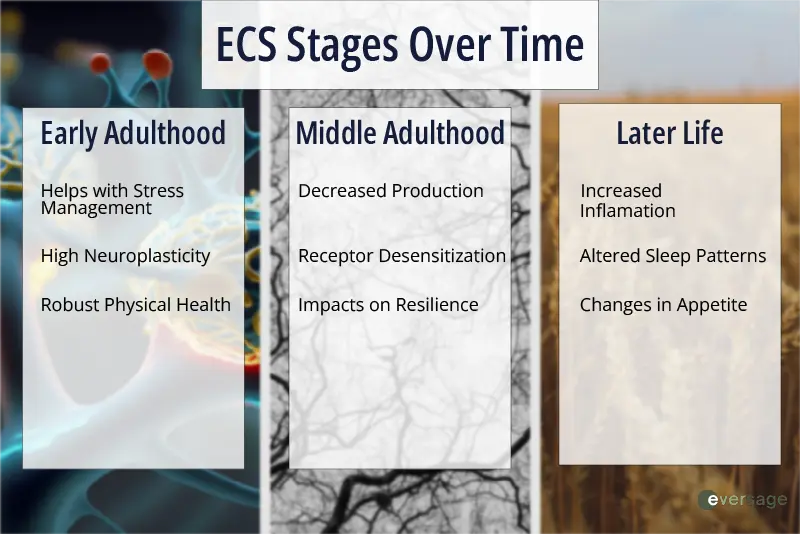
During your 20s and 30s, your ECS is generally operating at what many consider its peak efficiency. This is a time when the system is often robust, characterized by a healthy density of cannabinoid receptors and ample production of endocannabinoids. Your body is typically resilient, quick to recover, and adept at maintaining internal balance. The ECS plays a crucial role in:
- Stress Management: Helping your body adapt to daily stressors and regulate your mood.
- Neuroplasticity: Supporting your brain’s ability to form new connections and learn.
- Robust Physical Health: Contributing to efficient metabolism, strong immune responses, and pain regulation.
You’ll often find that a well-tuned ECS during this phase contributes to stable moods, good quality sleep, and a rapid ability to bounce back from physical exertion or mental challenges. Your body feels like it’s firing on all cylinders, and a healthy ECS is a major reason why.
Middle Adulthood (Subtle Shifts)
As you gracefully transition into your 40s and 50s, your ECS may begin to show more subtle, yet significant, changes. This phase can be marked by a gradual decrease in the efficiency of your ECS. You might experience:
- Decreased Endocannabinoid Production: Your body might naturally produce fewer of its own cannabis-like compounds, meaning there are fewer internal messengers to maintain that perfect balance.
- Receptor Desensitization: The cannabinoid receptors might become slightly less sensitive, requiring more stimulation to achieve the same effect, or perhaps responding differently than they once did.
- Impacts on Resilience: These shifts can subtly affect how quickly you recover from stress, how you manage pain, and even your perception of well-being. What once felt like a minor ache might linger a bit longer, or stress might feel more pronounced.
These changes are often imperceptible day-to-day but can, over time, influence your overall physiological resilience and how your body adapts to its environment. It’s during this stage that some individuals might start noticing that cannabis use affects them differently than it did in their younger years.
Later Life (The Golden Years)
In your 60s and beyond, the natural progression of aging means that the changes in the ECS become more pronounced. Research suggests there can be a more significant decline in both receptor density and overall endocannabinoid tone. This means fewer “receiving stations” and potentially less “messenger” traffic. This shift is strongly linked to several common age-related challenges:
- Increased Inflammation: A less active ECS can contribute to chronic low-grade inflammation, a hallmark of aging.
- Altered Sleep Patterns: The ECS plays a key role in regulating sleep-wake cycles, and its decline can exacerbate sleep disturbances.
- Changes in Appetite: Appetite regulation can be affected, sometimes leading to a decreased appetite or altered metabolic responses.
- Cognitive Function: The ECS’s involvement in memory and learning means that its age-related decline can impact cognitive sharpness.
Understanding these natural progressions helps you anticipate and address them proactively, allowing you to support your ECS and overall health as you embrace your golden years.
Avoiding the Misfire: Common Mistakes and How to Stay in Sync
One of the easiest traps to fall into as you age is assuming your body responds the exact same way it always has. But the dynamic nature of your ECS means that what worked perfectly for you in your 20s or 30s might not be optimal, or even pleasant, in your 50s or 60s. A common pitfall for many cannabis consumers is failing to adjust their approach to consumption, or even their general wellness practices, as their ECS naturally evolves.
Consider the experience of watching someone’s tolerance or sensitivity to cannabis shift dramatically over decades. A strong indica that once brought profound relaxation might, years later, feel overwhelming or even anxiety-inducing at the same dose. Conversely, a different cannabis strains that used to provide a gentle lift might now feel almost imperceptible. The heartbreak comes from not listening to your body’s changing signals, leading to experiences that are less than ideal.
The fix for this common misfire? You need to become an active, empathetic observer of your own internal system. This means being ready to adapt and refine your choices to match your current needs, not your past preferences. It’s about adjusting your cannabis dosage, perhaps exploring different cannabinoid ratios, or even revisiting how you manage stress and sleep. Your body is constantly sending you messages; the art is in learning to truly hear them and respond with care and awareness.
Quick Hits Q&A: Your Aging ECS in the Spotlight
Let’s hit some rapid-fire questions about your ECS and its journey through time!
- Q: Does cannabis use accelerate ECS aging?
- A: Current research suggests that moderate, responsible cannabis use doesn’t necessarily accelerate the aging of your ECS. In fact, some studies even point to cannabinoids offering neuroprotective benefits, though more long-term research is always emerging to paint a fuller picture.
- Q: Can I “boost” my ECS as I age?
- A: While you can’t entirely stop the hands of time, you absolutely can support your ECS’s health as you age! Lifestyle factors like a balanced diet rich in omega-3s, regular exercise, effective stress management techniques, and even certain plant compounds (like those found in cannabis and other botanicals) are powerful allies for a well-functioning ECS.
- Q: Will my tolerance to cannabis always increase with age?
- A: Not necessarily! In fact, many people find their sensitivity to cannabis can increase as they age. This might be due to fewer available cannabinoid receptors, changes in metabolism (which affects how long compounds compounds stay in your system), or alterations in body fat percentage. If you’re using cannabis, always remember the golden rule: start low and go slow, especially as you get older.
Embrace the Evolution, Master Your Wellness
Your Endocannabinoid System is an incredible, adaptable network, a lifelong companion constantly evolving alongside you through every stage of life. By understanding its intricate dance from the vibrant energy of early adulthood to the nuanced wisdom of your golden years, you empower yourself to make more informed, compassionate choices about your health, your lifestyle, and your relationship with cannabis. Embrace the changes your body naturally undergoes, listen intently to its subtle cues, and continue to explore how you can best support this vital internal system for optimal well-being. No matter your age, the journey of self-discovery and wellness is always yours – keep exploring, keep learning, and keep thriving!
Ready to further explore how cannabis can fit into your evolving wellness journey? Discover more insights on our blog!