

You’ve explored the expansive world of cannabis, navigated its diverse strains, and likely familiarized yourself with the superstar cannabinoids: THC for its iconic euphoria and CBD for its widespread calming effects. They’re undeniably powerful, shaping countless experiences and wellness routines. But what if you’ve only been scratching the surface? Imagine a hidden layer of complexity, a nuanced symphony of compounds working behind the scenes to fine-tune your well-being. This isn’t fiction; it’s the exciting reality of minor cannabinoids.
Introduction
These lesser-known compounds, present in smaller quantities in the cannabis plant, are far from minor in their potential impact. Think of them as the unsung heroes, the specialist players on a championship team, each bringing a unique talent to the field. Today, you’re going to dive deep into the fascinating world of CBG, CBC, and THCV – three minor cannabinoids that are rapidly gaining recognition for their distinct therapeutic profiles and their crucial role in unlocking the full potential of your cannabis experience. Get ready to personalize your wellness journey like never before.
The Minor League All-Stars: Why You Should Care About CBG, CBC, & THCV
You might be thinking, “Why complicate things? THC and CBD seem to do the trick.” And it’s true, they’re incredible compounds. But when you start exploring minor cannabinoids, you discover a whole new dimension of cannabis’s influence on your body. Your endocannabinoid system (ECS), the intricate network that helps regulate everything from mood and sleep to pain and appetite, isn’t just listening to THC and CBD. It’s paying attention to all the cannabinoids, terpenes, and flavonoids present in the plant.
This is where the magic of the “entourage effect” truly shines. While each minor cannabinoid offers unique benefits, their real power often emerges when they work together, amplifying and modulating the effects of one another and the major cannabinoids. By understanding CBG, CBC, and THCV, you equip yourself with the knowledge to select products that go beyond general relief, targeting specific wellness goals with precision. You’re not just consuming cannabis; you’re crafting a tailored experience that speaks directly to your body’s individual needs.
Your Guide to Cannabis’s Hidden Gems: A Deep Dive into CBG, CBC, and THCV
Ready to meet the individual stars of our minor cannabinoid lineup? Each one brings a unique set of skills to your wellness playbook.
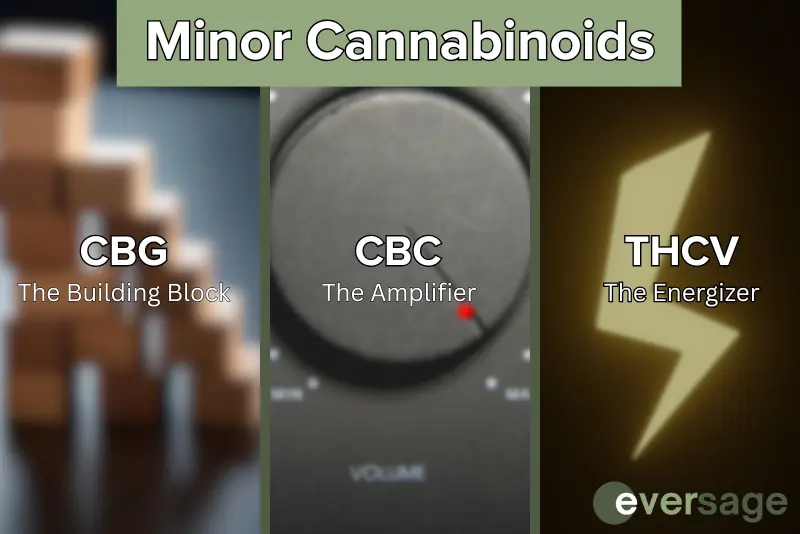
CBG: The “Mother Cannabinoid” – Building Blocks of Bliss
Imagine a blueprint, a foundational compound from which almost all other cannabinoids are born. That’s CBG, or cannabigerol, often affectionately called the “mother cannabinoid.” In the raw cannabis plant, you’ll find CBGA (the acidic form), which converts into CBG, and then, through enzymatic processes, further transforms into THCA, CBDA, and CBCA. This means without CBG, you wouldn’t have the THC or CBD you know so well!
But CBG isn’t just a precursor; it’s a powerful cannabinoid in its own right, directly interacting with both CB1 and CB2 receptors in your ECS. What does this mean for you?
- You’ll appreciate CBG’s potential to soothe inflammation, making it a promising candidate for discomfort.
- Emerging research suggests CBG could help protect brain cells, an exciting prospect for neurological wellness.
- For those seeking to boost their appetite, CBG has shown promise in this area.
- Like CBD, CBG may contribute to overall pain management without the intoxicating effects of THC.
- Studies have highlighted CBG’s potent antibacterial properties, even against resistant strains.
When you seek out products rich in CBG, you’re tapping into a fundamental compound that supports your body’s balance in multiple ways, laying a strong foundation for your wellness.
CBC: The Entourage Effect’s Unsung Hero – Amplifying Your Experience
Cannabichromene, or CBC, is a true team player, a cannabinoid that significantly contributes to the entourage effect even though it doesn’t bind strongly to the primary CB1 and CB2 receptors that THC and CBD interact with. Instead, CBC works through other pathways, like the TRPA1 and TRPV1 receptors, which are involved in pain perception and inflammation, and it can also increase levels of anandamide levels, a natural endocannabinoid.
How might CBC enhance your life?
- You might find CBC contributes to an uplifted mood due to its potential antidepressant properties.
- Perhaps one of CBC’s most exciting potentials is its ability to promote neurogenesis – the growth of new brain cells – which is truly remarkable for maintaining cognitive health.
- Similar to CBG and CBD, CBC contributes to the plant’s overall anti-inflammatory and analgesic effects, offering you another layer of comfort.
- Early studies indicate CBC may play a role in inhibiting tumor growth, an area of ongoing research that many find incredibly promising.
When you choose products with significant CBC content, you’re not just addressing symptoms; you’re potentially supporting your body’s ability to repair and rejuvenate, making it an essential component of a truly holistic approach.
THCV: The “Diet Cannabinoid” – Energy, Focus, and Appetite Control?
If you’re looking for a cannabinoid with a truly unique profile, meet THCV, or tetrahydrocannabivarin. This compound stands apart with its dual nature: at lower doses, it’s a non-intoxicating antagonist of the CB1 receptor, while at higher doses, it can become psychoactive. But it’s the lower dose effects that have earned it intriguing nicknames.
What could THCV bring to your routine?
- Unlike THC, which often stimulates appetite, THCV is known for its potential to curb hunger, making it an appealing option if you’re managing your weight.
- Many users report a clear-headed, energetic feeling with THCV, potentially enhancing your focus without jitters.
- Research suggests THCV may help regulate blood sugar levels, showing promise for supporting metabolic health.
- Early studies indicate THCV could promote bone cell growth, which is exciting for bone density and healing.
- Some evidence suggests THCV might reduce symptoms of panic and anxiety, particularly in individuals prone to panic attacks.
When you choose products rich in THCV, you’re exploring a cannabinoid that offers a unique combination of potential energy, focus, and appetite management, making it a distinct tool in your wellness kit. Just remember that finding the right dosage is key for you to experience its non-intoxicating benefits.
Unlocking the Entourage Effect: Crafting Your Personalized Blend
The real beauty of minor cannabinoids comes alive when you understand their interplay within the entourage effect. This isn’t about isolating single compounds; it’s about appreciating the symphony. When cannabinoids, terpenes (the aromatic compounds that give cannabis its scent and flavor), and flavonoids (another group of beneficial plant compounds) work together, they create a more profound and balanced effect than any compound could achieve on its own.
Your journey of discovery involves carefully selecting full-spectrum or broad-spectrum products that retain a rich profile of these compounds. You’re encouraged to experiment with different strains and product formulations, paying attention to not just the THC and CBD content, but also the presence of CBG, CBC, and THCV. This allows you to discover the specific combinations that resonate most powerfully with your body and your wellness goals. Once you truly dive into understanding this synergy, it’s another layer of understanding that will elevate your choices.
Common Pitfalls and How to Navigate the Minor Cannabinoid Maze
Embarking on any new wellness path comes with its potential missteps. To ensure your exploration of minor cannabinoids is rewarding and effective, you should be aware of a few common challenges.
Mistake #1: Overlooking the “Small Print” on Labels
In the excitement of trying something new, it’s easy to focus only on the headline numbers: the THC and CBD percentages. But for minor cannabinoids, the real insights are in the details. You are advised to always meticulously check product labels, seeking out “full-spectrum” or “broad-spectrum” options that indicate the presence of a wider range of compounds. More importantly, always demand and review third-party lab reports, often called Certificates of Analysis (CoAs). These reports are your transparent window into the exact cannabinoid profile, ensuring you know exactly which minor cannabinoids are present and in what concentrations. Don’t skip this crucial step!
Mistake #2: Expecting Instant, Isolated Effects
You might be used to the immediate, distinct effects of THC or the more noticeable calming of CBD. However, minor cannabinoids, especially at typical concentrations, often work more subtly. Their benefits can be cumulative, building over time, and frequently manifest as part of the larger entourage effect rather than a singular, dramatic sensation. Approach your experimentation with patience and an open mind. Give your body time to respond and observe the more nuanced shifts in your well-being. Thinking of them as essential ingredients in a complex recipe, rather than stand-alone cures, will help manage your expectations.
The Hidden Treasure: A Lesson in Broadening Your Horizons
Many cannabis enthusiasts, including those who felt they had a solid handle on their preferences, initially fixated on just THC and CBD. They often experience a profound “aha!” moment when they finally open themselves up to the full spectrum of the plant. There are countless stories of individuals who struggled to find consistent relief or achieve specific wellness goals until they started paying attention to and actively seeking out minor cannabinoids. The difference a comprehensive approach makes can be massive. For example, someone struggling with focus might find their perfect blend only after incorporating THCV, or someone seeking enhanced inflammation relief might discover CBG as their missing link. This broadened perspective often leads to a more effective, tailored, and satisfying cannabis wellness journey, proving that sometimes the greatest treasures are found when you look beyond the obvious.
Quick Hits Q&A: Your Minor Cannabinoid Conundrums Solved
Are minor cannabinoids psychoactive?
Most minor cannabinoids, including CBG and CBC, are non-intoxicating and will not produce a “high.” THCV is a notable exception; at lower doses, it’s non-psychoactive and can even counteract some of THC’s effects, but at higher doses, it can become mildly intoxicating.
How do I find products rich in specific minor cannabinoids?
To find products rich in specific minor cannabinoids, you should research cannabis strain genetics known for producing higher levels of these compounds, look for product formulations specifically advertised as “CBG-rich” or “THCV-focused,” and always verify content with third-party lab results (Certificates of Analysis) before purchasing.
Can I combine minor cannabinoids for better results?
Absolutely! You are encouraged to experiment with combining minor cannabinoids, as this is how you truly harness the entourage effect. By blending products or choosing full-spectrum options, you can create a synergistic effect where the compounds work together to amplify benefits. Always start with a low dose and increase gradually to find your optimal balance.
Do minor cannabinoids show up on drug tests?
While most standard drug tests do not screen specifically for minor cannabinoids like CBG, CBC, or THCV, it is crucial to remember that many products containing these compounds are derived from cannabis and may also contain trace amounts of THC. If you consume full-spectrum products, even those with very low THC content (below 0.3%), there is a potential for THC metabolites to accumulate in your system and trigger a positive drug test result.
Conclusion & Final Thoughts: Embrace the Full Spectrum of Wellness!
You’ve just taken a deep dive into the extraordinary world of minor cannabinoids, uncovering the unique powers of CBG, CBC, and THCV. It’s clear these compounds are far more than just supporting characters; they are essential players in the grand tapestry of cannabis wellness. By expanding your understanding beyond the familiar THC and CBD, you empower yourself to craft a truly personalized and effective wellness regimen.
So, go forth with this newfound knowledge! Explore product labels, seek out third-party lab results, and don’t be afraid to experiment thoughtfully with different formulations. Your journey into the full spectrum of cannabis is an exciting adventure, full of potential for tailored relief and enhanced well-being. What minor cannabinoid are you most excited to explore first? Share your thoughts and discoveries in the comments below, or continue your cannabis education by checking out another related fun topic!